What Is A Gantt Chart And Why Is It Essential When Building?
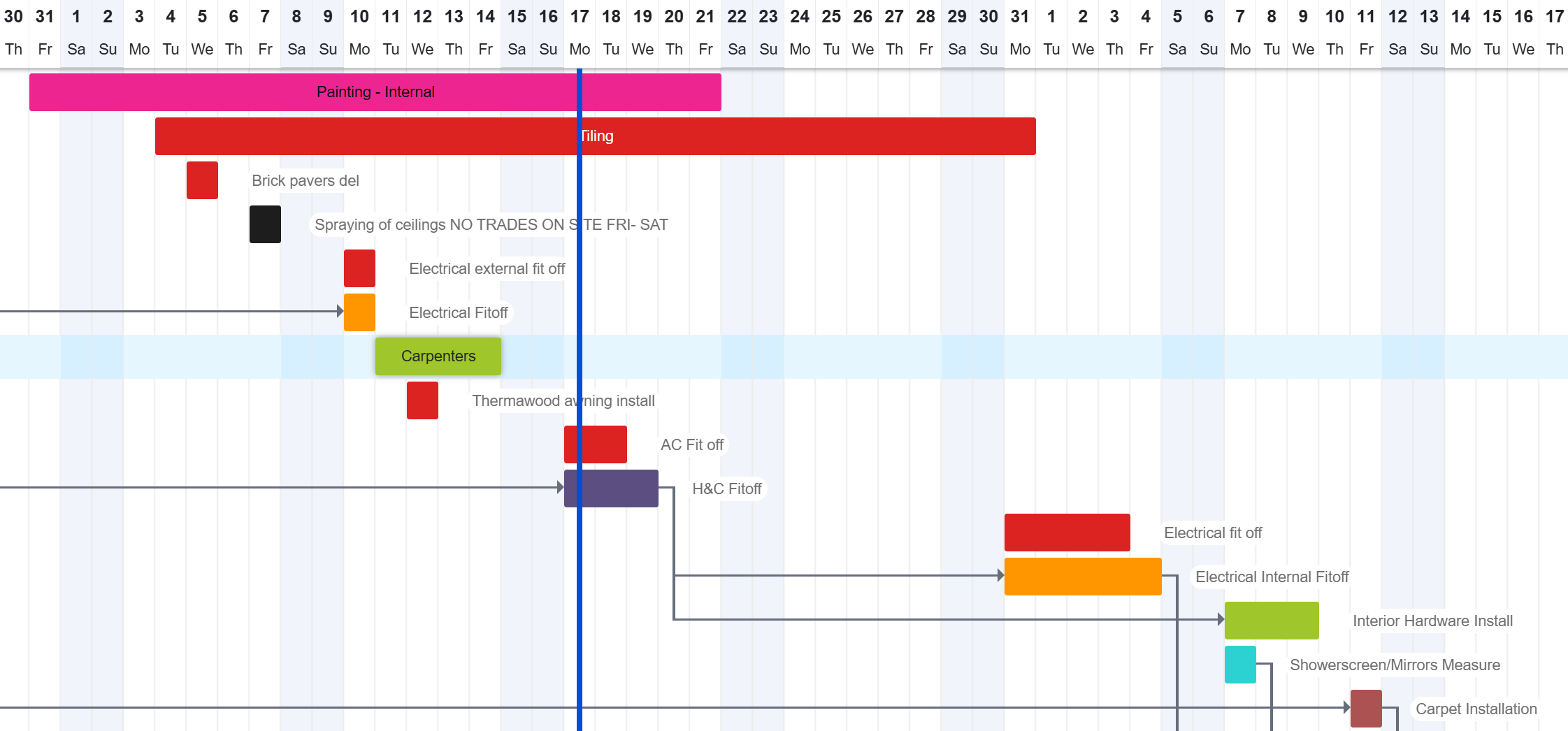
A Gantt chart gives homeowners a clear, planned timeline for their building project, showing when each activity starts and finishes from construction through to handover. It helps Transform Homes coordinate trades, materials and resources, identify scheduling conflicts early, manage delays and keep the project tracking toward its agreed completion date.
How does a Gantt chart help manage a home build?
A Gantt chart is a detailed construction schedule that maps the sequence of activities required to complete a home. At Transform Homes, we use it to coordinate the project from the beginning of construction through to final handover.
The schedule helps us:
- Allocate internal resources and contractors.
- Coordinate trades and construction activities.
- Identify potential scheduling conflicts.
- Allow for material and product lead times.
- Schedule contractors before they are needed on site.
- Identify owner-supplied items that need to be ordered in advance.
- Monitor progress against the agreed completion date.
- Identify delays early so their impact can be managed.
- Link Invoices to progress milestones
For a Melbourne home build, this level of planning is important because construction involves many interdependent activities. A delay in one area can affect several trades that follow.
What does a Gantt chart show during construction?
A well-prepared construction Gantt chart shows the planned sequence and timing of activities across the entire project.
This means a homeowner can see whether the project is tracking ahead, on schedule or behind the original plan.
At Transform Homes, the first action we take when a project commences is to establish a baseline. This locks in the original project plan, providing a clear benchmark against which progress can be measured.
From there, our team continually updates the live Gantt chart schedule—at least weekly, and sometimes more frequently—so there is always an accurate, up-to-date picture of where the project stands. This makes it easy to compare actual progress against the original baseline and identify any changes or delays. Having an up-to-date schedule in our Gannt chart transparently conveys progress on your build.
Importantly, all of this information is available to our clients 24/7 through the Owner Portal. The live Gantt chart is also a key component of the weekly written update we provide on every project.
These weekly written updates are an essential part of our communication process, giving our clients a clear and consistent understanding of progress on site, what has been completed, what is happening next, and how the project is tracking against the original plan.
How does Transform Homes use Gantt charts to manage delays?
Construction schedules can change. Illness, material delays, contractor availability and other unforeseen circumstances can affect individual activities.
The benefit of having a live Gantt chart is that these changes can be identified quickly.
For example, one activity may fall a day or two behind while another finishes ahead of schedule. What matters is the overall position of the project and whether the completion date remains achievable.
When a scheduling issue occurs, Transform Homes can assess the impact and take appropriate action to minimise the delay. If an opportunity arises to bring the completion date forward, the schedule can also make that opportunity visible.
Our experience is that careful scheduling frequently allows us to deliver ahead of the original schedule.
How far in advance should owner-supplied items be planned?
Owner-supplied products should be identified well before they are required on site.
For example, if a homeowner is responsible for supplying tiles, those tiles need to be selected, ordered and delivered in time for the relevant construction stage.
A detailed Gantt chart helps identify these requirements early, giving homeowners enough time to organise their purchases and deliveries.
Can homeowners monitor their building schedule?
Yes. When you build with Transform Homes, you receive access to your project Gantt chart so you can monitor progress throughout the build.
The schedule is available 24/7 through Buildertrend, allowing you to check it from your phone, laptop or iPad.
This gives homeowners greater visibility of the project and a shared understanding of how construction is progressing toward the planned completion and handover date.
Who manages the Gantt chart for my build?
Transform Homes has a dedicated person in the office responsible for managing resources and keeping the Gantt chart up to date.
This provides an active approach to project scheduling rather than treating the construction timeline as a one-off estimate created at the beginning of the build.
The schedule is continually used to coordinate resources, monitor progress and identify potential issues.
Should a builder provide a Gantt chart before you sign a contract?
Yes. Homeowners should ask to see a detailed construction schedule before signing a building contract.
A Gantt chart should demonstrate that the builder has considered the sequence, resources, trade availability and lead times required to complete the project.
Before signing, ask:
- Can I see the proposed Gantt chart for my build?
- What is the planned construction timeframe?
- How are trades and contractors being scheduled?
- How are material lead times accounted for?
- How are owner-supplied items incorporated into the schedule?
- How will I be notified if the schedule changes?
- How will delays be managed?
If a builder cannot provide a construction schedule before you commit to the project, it is reasonable to ask why.
A construction timeframe should be based on a considered project plan rather than simply being an estimate of how long the builder expects the project to take.
Does Transform Homes provide a Gantt chart?
Yes. Transform Homes provides a Gantt chart for every build, giving you visibility of the planned construction schedule and ongoing progress.
For our clients, this approach provides a clearer understanding of how the project is planned, how individual activities connect and how the build is tracking toward handover.
At Transform Homes, we believe a well-planned build starts with a well-planned schedule.
Ready to have your Melbourne home build planned properly?
If you are considering building a new home in Melbourne’s north and north-eastern suburbs, talk to Transform Homes about your project, construction schedule and available options.
Contact Transform Homes today to start planning your build with a clear pathway from construction through to handover.
About the Author
Greg brings nearly 25 years of experience in the building industry, with extensive knowledge across residential and commercial construction projects.
His experience spans project planning, construction and practical building management, with a strong focus on quality, craftsmanship, professionalism and attention to detail.
Through his writing, Greg shares practical building advice and industry insights to help homeowners make informed decisions when planning and building their homes.